
Trace Charlton County Owners Backward
Every good chain starts with one verified current deed. The rows below stand for transfers you still need to prove. They are not real owners. Fill each one from the instruments, moving newest to oldest.
| Transfer date | Grantor to grantee | Deed type | Book/page |
|---|---|---|---|
| Newest recorded transfer | Prior owner to current grantee | As indexed | Record exact reference |
| Next earlier transfer | Earlier owner to the prior owner | As indexed | Record exact reference |
| Older book entry | Continue only after description match | As written in book | Clerk-supplied citation |
The legal description is what holds every row together. Street names change, rural tracts often lack numbers, and one person can own several parcels. Only the description proves the land stayed the same.
Reconstruct Charlton County's Deed Chain
Start online with the GSCCCA Real Estate Deed Search. Pull the current owner's acquisition deed first. Read the grantor's name, then hunt that same grantor as a grantee in the earlier transfer of the same land.
- Copy the present APN and legal description from the parcel and latest deed.
- Record the current deed's grantee, grantor, instrument, date, and book/page.
- Search the grantor as an earlier grantee and compare the full land description.
- Repeat until the index no longer reaches the needed year, then request the older book and index.
- Grantor
- The party conveying the stated interest.
- Grantee
- The party receiving that interest.
- Chain of title
- The ordered series of instruments connecting ownership through time.
- Reverse index
- An index arranged by grantee, useful for finding how a seller once acquired land.
- Quitclaim and warranty deed
- Different conveyance forms whose effect must be read from the instrument.
Never skip a corrective deed, executor's deed, or assent just because no cash sale shows. Instruments without money still move title. Each one belongs in the chain.
Go Beyond Charlton County's 1999 Index
GSCCCA says its statewide Real Estate Deed Index holds county data from January 1, 1999. Older material is added over time. That cutoff is only a milestone. It does not mean every earlier Charlton County deed image is online. The local clerk keeps the real run of deed books and grantor and grantee indexes. The office also holds plats, scans, microfilm, and office-terminal access. For anything before the index, the clerk is the authority.
Online cutoff. The statewide milestone begins January 1, 1999; ask the Charlton County clerk where each earlier deed book and index can be read.
The GSCCCA real-property source documents the search routes by name, book and page, subdivision, lot, address, map, and instrument. Its screen also gives context for how the index itself works.
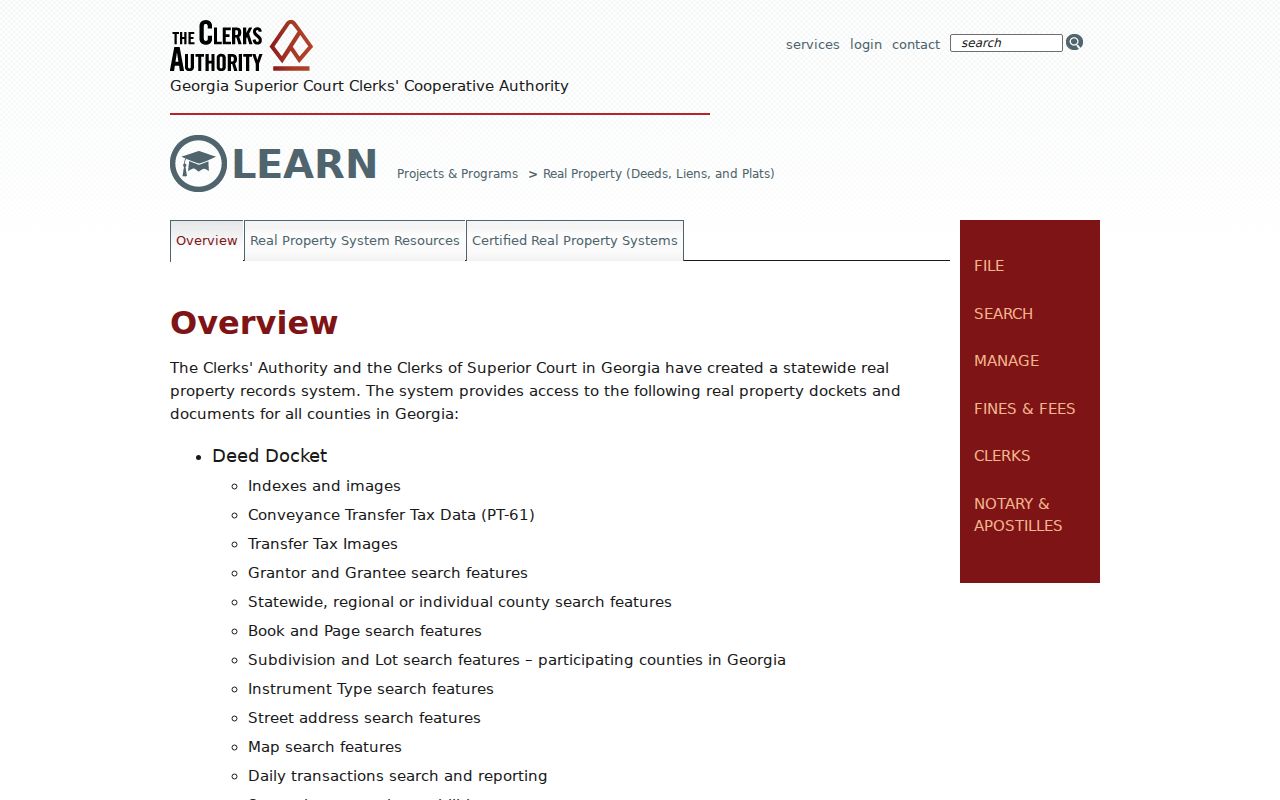
Use the source to find a citation. Then preserve the cited instrument or book page as evidence.
Bridge Charlton County's Historic Owner Gaps
The Charlton County Historical Society holds an 1855 tax digest plus digests covering 1908 through 1945. A digest can pin a surname, tract description, value, or tax district to a year when the deed trail runs cold. Treat these as leads. They never replace the conveyance itself. The Historical Society collection page displays the full listing.
The same collection description also lists an 1890 Folkston map, county maps from 1867 and 1869 through DLG, and other local records. Old names often land on those documents first.
Use Charlton County Herald Owner Clues
The Society reports digitized Charlton County Herald issues from 1908 through 1929. A keyword index spans 1908 through 1945. Search a former owner's surname beside terms like "deed," "land," "acre," "administrator," "executor," "sheriff," or "tax sale." A subdivision name works too. A legal notice can explain why a transfer happened or expose a missing estate sale. But the notice conveys nothing by itself. Return to the clerk's deed, lien, release, and book references for proof.
Extend Charlton County Owners Before Formation
Charlton County was cut from Camden County in 1854. Ware County land was added in 1855. So an older instrument may sit under a predecessor county's index. Let the land description and the boundary date decide where you look. Searching every old surname without geographic control only wastes effort. Historic descriptions often name St. George, Moniac, Racepond, Winokur, Kings Ferry, Trader's Hill, or Newell instead of a street. Rail lines, creeks, roads, and adjoining-owner calls can carry the tract across those years too.
Explain Charlton County Probate Transfers
Sometimes a prior owner died and no ordinary sale follows. Look for an executor or administrator deed, an assent to devise, an estate petition, a will, letters, a sale order, or a final discharge. The Charlton Probate Court record proves authority to act. The recorded land instrument ties the event to the parcel. Tax sales, security deeds, liens, releases, lis pendens, and quiet-title orders can also break a tidy sequence. Record them beside the deed chain whenever they touch the same legal description. Never treat a case number alone as a transfer.
Request Older Charlton County Owner Books
The Clerk of Superior, State & Juvenile Courts sits at 1520 Third Street, Suite A, Folkston, GA 31537, phone 912-496-2354. Reach the records through the clerk's official links, the office terminal, a call, or the counter. Ask which earliest index covers your tract, and whether each volume is original, scanned, or microfilm. Confirm current copy and certification fees before ordering. Georgia Archives and the Digital Library of Georgia add map and item-level leads, including Charlton maps from 1867 and 1869 and an 1899 indenture. Save every item title, date, collection, page or image number, and direct URL.
Mark Charlton County Owner Limits
A tax digest, newspaper notice, city directory, or historic map can hint at who came before. None of it can replace a missing deed. Treat doubtful connections as gaps and write them down as such. Two people can share a surname. That does not make them the same owner of record. So hold off on merging identities until a parcel description and date line up on both records.
Tracing former owners has honest uses. House history, estate work, a purchase review, or title research all count. It is never a tool for tracking, harassing, or targeting a living person. One certified copy may be all you need. Then the Charlton County deed records route beats rebuilding an entire ownership chain by hand.